SEC
The SEC Has a Gator Problem
Florida's frontcourt set a punishing standard during a 16–2 SEC season. Four starters return from that No. 1 seed, but Texas has assembled the size to challenge them, Arkansas is turning to another elite freshman guard, and Tennessee's rebuilt backcourt could make the title race considerably tighter.
The cover line
Milan Momcilovic goes from eliminating Kentucky to playing for it, Tyler Tanner returns to a rising Vanderbilt, and Auburn's NIT-winning backcourt takes aim at an NCAA return. They lead the next wave in a league we project to send 11 teams to the NCAA Tournament.











Projected champion
Florida
The team to beat on our official board
Dark horse
Mizzou
The team most likely to break the bracket
Projected NCAA bids
11
Four Blue Ribbon top-10 teams, led by Florida, headline a league we project to earn eleven NCAA bids.
Chaos rating
58 / 100
How likely the board is to get weird
The quick read
Conference superlatives
The opening tip
Gator Expectations
Florida's imposing frontcourt is back together. To turn another SEC title run into a longer March, the Gators need better shooting from the players around it.
Florida spent last winter making the SEC race look settled. The Gators finished 16–2, won the league by three games and earned a No. 1 seed. Against the conference's four eventual Sweet 16 teams, they went 4–0 with an average winning margin of 23.5 points. Thomas Haugh, Alex Condon, Rueben Chinyelu and Boogie Fland return from that team. Todd Golden has every reason to expect another championship contender, and the rest of the SEC has a considerable gap to close. Haugh gives Golden room to change the shape of the offense. Moving him to power forward creates room for another shooter, although it takes either Condon's passing or Chinyelu's rebounding out of that lineup. Urban Klavzar, a 40.6 percent three-point shooter, makes those smaller combinations attractive. A defender helping off him cannot stay in the lane as comfortably as one assigned to Fland, who shot 24 percent from deep. Florida can overwhelm an opponent with size; against a defense packed around its big men, Golden needs more ways to spread the floor. For the first time at Florida, Golden will enter consecutive seasons with the same starting point guard. Fland's 121 assists against 55 turnovers provide a sound foundation. A reliable pull-up or catch-and-shoot three would change where defenders meet him and how much help they can give against Condon. Denzel Aberdeen's return from Kentucky would add another experienced scorer, but his fifth-year eligibility remains unresolved. Better perimeter offense would give Florida more protection on a night like its second-round loss to Iowa, when the Hawkeyes matched the Gators on the glass and Chinyelu managed one rebound. Texas offers the strongest reason to expect a closer race. Sean Miller's first season ended in the Sweet 16 after a 9–9 conference finish. Now the Longhorns have to turn a good March into five good months. Matas Vokietaitis is the lone returning starter, surrounded by 11 newcomers. He put 23 points and 16 rebounds on BYU in the NCAA Tournament; adding David Punch, who blocked 66 shots for TCU, gives Texas a formidable pair around the basket. Punch can challenge a driver while Vokietaitis stays close enough to rebound, a useful arrangement against Florida's size. Isaiah Johnson averaged 16.9 points as a Colorado freshman and attempted 195 free throws, making him a threat to reach the rim as well as spread the floor. Mikey Lewis brings shooting and experience from Saint Mary's. Johnson's ability to beat the first defender should force opposing centers to choose between stopping the ball and staying with Vokietaitis. We have Texas second. Miller's new guards and big men will have to develop their timing quickly enough to justify it. John Calipari is beginning again at guard, too, after Darius Acuff Jr. and Meleek Thomas combined for 1,424 points. Acuff's 30 points and 11 assists against Vanderbilt delivered Arkansas the SEC Tournament championship. Asking Jordan Smith Jr. to inherit that job immediately would be a considerable demand even for the national high school player of the year. Billy Richmond III's late-season surge gave Arkansas another player worth building around. Richmond scored at least 20 points in five straight SEC games, then produced 15 points and 10 assists against High Point in the NCAA Tournament. Richmond and Smith give Arkansas two powerful perimeter attackers, while Georgia transfer Jeremiah Wilkinson brings established SEC scoring. Calipari can push after rebounds and let Richmond attack before the defense finds its matchups. The concern comes when those early opportunities disappear: Acuff and Thomas supplied an enormous amount of late-clock offense. Richmond's passing gives Calipari a way to get Smith off the ball without losing another creator, and a chance to distribute the responsibility that Acuff handled so well. Tennessee's ambition has become painfully specific. Rick Barnes has taken the Volunteers to three straight Elite Eights without reaching the program's first Final Four. Juke Harris arrives from Wake Forest after averaging 21.4 points, making 87 threes and attempting 249 free throws. He can punish a defender who backs off and get to the line against one who crowds him. Harris and fellow newcomers Terrence Hill Jr. and Jalen Haralson can share the creation after Ja'Kobi Gillespie and Nate Ament's departures. The concern is behind them: Miles Rubin brings shot blocking, but Ralph Scott faces six to eight months out after knee surgery and Jalen Washington remains ineligible. Foul trouble for Rubin could force Barnes into smaller lineups against some imposing frontcourts. Kentucky found a particularly direct way to address its own March disappointment: sign the shooter who helped end its season. Milan Momcilovic scored 20 against the Wildcats in Iowa State's second-round win, then arrived in Lexington after making 136 threes at 48.7 percent. Mark Pope can make defenses follow him through screens and use the attention to open catches for Malachi Moreno inside. Against Florida, those possessions could force Haugh to chase a shooter instead of helping his big men near the basket. Alabama can stretch a frontcourt, too. Drew Fielder shot 40.9 percent from three at Boise State, and playing him away from the basket should open driving lanes for Amari Allen. Allen averaged 11.4 points, 6.9 rebounds and 3.1 assists as a freshman; Nate Oats can give him more of the offense after Labaron Philon's departure. Replacing Aiden Sherrell's rim protection is a separate concern. The lineup that creates the most space for Allen could also be vulnerable to the SEC's better offensive rebounding teams. At Vanderbilt, Mark Byington has taken the Commodores to consecutive NCAA Tournaments and delivered their first tournament win since 2012 in just two seasons. Tyler Tanner withdrew from the draft after setting school records with 184 assists and 86 steals. Now he gets Washington State transfer Ace Glass, whose 71 threes broke Klay Thompson's freshman school record. Glass can shoot off Tanner's penetration, and sharing the ballhandling should let Byington keep a creator on the floor when Tanner rests. We have Vanderbilt eighth; Tanner is the player most capable of making that placement look timid. Auburn is asking its returning guards to turn an NIT championship into an NCAA return. Kevin Overton and Tahaad Pettiford combined for 50 points in the final, with Overton hitting the three that forced overtime against Tulsa. Pettiford also had eight assists. Steven Pearl can trust both to initiate the offense, and Overton's 41.3 percent three-point shooting makes him a dangerous outlet when opponents send help at Pettiford. Eligibility decisions could still change the league's depth. RJ Luis Jr. will not play for LSU, and Will Wade awaits rulings on other additions; Missouri is still waiting on Mark Mitchell's fifth-year case. Our pick is Florida at 14–4, with Texas closest. That gives the challengers credit for their additions while respecting the distance they have to make up. Golden can still win through rebounding and interior defense as he experiments with more shooting around Haugh and Condon. If Fland makes enough jumpers to keep defenders attached to him, the SEC could be facing a better offense from a team it already struggled to contain.
The defining storylineFlorida returns four starters from a 16–2 SEC champion. Texas has the size to challenge its frontcourt; Arkansas and Tennessee will try to expose it with pace and perimeter creation.
Official projection + model comparison
The big board
See how every team stacks up through projected records, finish ranges, and the model’s view of the race.
Ranking machine · comparison at a glance
Editorial board vs. model
Teams are ordered by the official Shooty Hoops editorial rank.
- 1FloridaThe SEC's best frontcourt returns, while Isaiah Brown, Alex Lloyd and a deeper shooting rotation offer Florida room to improve around Haugh, Condon and Chinyelu.Conf / overall14-4 / 24-7TierFavoriteCeiling / floor1–3Boards agree · #11Official rankFloridaThe SEC's best frontcourt returns, while Isaiah Brown, Alex Lloyd and a deeper shooting rotation offer Florida room to improve around Haugh, Condon and Chinyelu.Boards agree · #1Conf / overall14-4 / 24-7TierFavoriteRange1–3
- 2TexasJohnson's scoring, Punch's versatility and Vokietaitis' interior efficiency put Texas in the title race, with a crowded wing competition offering several ways to complete the lineup.Conf / overall13-5 / 26-6TierContenderCeiling / floor1–6Boards agree · #22Official rankTexasJohnson's scoring, Punch's versatility and Vokietaitis' interior efficiency put Texas in the title race, with a crowded wing competition offering several ways to complete the lineup.Boards agree · #2Conf / overall13-5 / 26-6TierContenderRange1–6
- 3ArkansasSmith headlines the recruiting class, but Richmond's development, Wilkinson's shooting and a crowded group of young forwards give Arkansas several routes back into the championship race.Conf / overall12-6 / 23-9TierContenderCeiling / floor1–8Boards agree · #33Official rankArkansasSmith headlines the recruiting class, but Richmond's development, Wilkinson's shooting and a crowded group of young forwards give Arkansas several routes back into the championship race.Boards agree · #3Conf / overall12-6 / 23-9TierContenderRange1–8
- 4TennesseeHarris, Hill and Ames give Tennessee several established scoring options, while Brown, Rubin and Lue will shape the balance of Barnes' rebuilt frontcourt.Conf / overall12-6 / 24-8TierContenderCeiling / floor1–7Boards agree · #44Official rankTennesseeHarris, Hill and Ames give Tennessee several established scoring options, while Brown, Rubin and Lue will shape the balance of Barnes' rebuilt frontcourt.Boards agree · #4Conf / overall12-6 / 24-8TierContenderRange1–7
- 5AlabamaAllen takes the wheel of an offense with more size, an intriguing stretch center and considerable responsibility awaiting its young wings.Conf / overall11-7 / 22-10TierTournament TeamCeiling / floor2–8Boards agree · #55Official rankAlabamaAllen takes the wheel of an offense with more size, an intriguing stretch center and considerable responsibility awaiting its young wings.Boards agree · #5Conf / overall11-7 / 22-10TierTournament TeamRange2–8
- 6AuburnPettiford and Overton return with more shooting around them and a frontcourt competition that will determine Auburn's progress beyond the NIT.Conf / overall10-8 / 21-11TierTournament TeamCeiling / floor3–10Boards agree · #66Official rankAuburnPettiford and Overton return with more shooting around them and a frontcourt competition that will determine Auburn's progress beyond the NIT.Boards agree · #6Conf / overall10-8 / 21-11TierTournament TeamRange3–10
- 7KentuckyMomcilovic is the attraction; the guard partnership and competition beside Moreno will decide how complete Pope's third Kentucky team becomes.Conf / overall9-9 / 20-12TierTournament TeamCeiling / floor3–11Boards agree · #77Official rankKentuckyMomcilovic is the attraction; the guard partnership and competition beside Moreno will decide how complete Pope's third Kentucky team becomes.Boards agree · #7Conf / overall9-9 / 20-12TierTournament TeamRange3–11
- 8VanderbiltTanner leads another NCAA contender, with Barrett sharing the ballhandling, Dak taking on more offense and Bing carrying a late-season promotion into a larger role.Conf / overall9-9 / 20-12TierTournament TeamCeiling / floor4–12Boards agree · #88Official rankVanderbiltTanner leads another NCAA contender, with Barrett sharing the ballhandling, Dak taking on more offense and Bing carrying a late-season promotion into a larger role.Boards agree · #8Conf / overall9-9 / 20-12TierTournament TeamRange4–12
- 9MizzouJason Crowe Jr. leads a rebuilt backcourt, while Jamier Jones, Trent Pierce and a substantial frontcourt give Missouri several ways to finish the possessions he starts.Conf / overall8-10 / 19-13TierDangerous MiddleCeiling / floor5–132 spots higher than published model · #119Official rankMizzouJason Crowe Jr. leads a rebuilt backcourt, while Jamier Jones, Trent Pierce and a substantial frontcourt give Missouri several ways to finish the possessions he starts.2 spots higher than published model · #11Conf / overall8-10 / 19-13TierDangerous MiddleRange5–13
- 10OklahomaOklahoma has several guards worth defending and a new passing center; its place in March will turn on whether a longer supporting cast brings comparable resistance at the other end.Conf / overall8-10 / 19-13TierDangerous MiddleCeiling / floor6–14Boards agree · #1010Official rankOklahomaOklahoma has several guards worth defending and a new passing center; its place in March will turn on whether a longer supporting cast brings comparable resistance at the other end.Boards agree · #10Conf / overall8-10 / 19-13TierDangerous MiddleRange6–14
- 11GeorgiaBlue Cain leads a familiar perimeter core with room for Catchings and Stagg to grow, while new centers inherit the difficult job of replacing Georgia’s protection around the rim.Conf / overall7-11 / 18-14TierDangerous MiddleCeiling / floor7–142 spots lower than published model · #911Official rankGeorgiaBlue Cain leads a familiar perimeter core with room for Catchings and Stagg to grow, while new centers inherit the difficult job of replacing Georgia’s protection around the rim.2 spots lower than published model · #9Conf / overall7-11 / 18-14TierDangerous MiddleRange7–14
- 12Miss St.Josh Hubbard returns with a more varied supporting backcourt, while Chris Jans rebuilds the forward rotation around shooting, physical size and a new starting option at center.Conf / overall7-11 / 17-15TierDangerous MiddleCeiling / floor8–162 spots higher than published model · #1412Official rankMiss St.Josh Hubbard returns with a more varied supporting backcourt, while Chris Jans rebuilds the forward rotation around shooting, physical size and a new starting option at center.2 spots higher than published model · #14Conf / overall7-11 / 17-15TierDangerous MiddleRange8–16
- 13SCLamont Paris has rebuilt around Kory Mincy's shooting, Shane Blakeney's two-way workload and an unusually experienced international frontcourt; whether that group produces enough offense against SEC length determines the recovery.Conf / overall6-12 / 16-16TierDangerous MiddleCeiling / floor9–161 spot lower than published model · #1213Official rankSCLamont Paris has rebuilt around Kory Mincy's shooting, Shane Blakeney's two-way workload and an unusually experienced international frontcourt; whether that group produces enough offense against SEC length determines the recovery.1 spot lower than published model · #12Conf / overall6-12 / 16-16TierDangerous MiddleRange9–16
- 14Texas A&MPJ Haggerty headlines a deep collection of perimeter scorers, but replacing Rashaun Agee's interior contribution will determine whether Bucky McMillan's second A&M team beats our skeptical projection.Conf / overall5-13 / 15-17TierLong ShotCeiling / floor9–161 spot higher than published model · #1514Official rankTexas A&MPJ Haggerty headlines a deep collection of perimeter scorers, but replacing Rashaun Agee's interior contribution will determine whether Bucky McMillan's second A&M team beats our skeptical projection.1 spot higher than published model · #15Conf / overall5-13 / 15-17TierLong ShotRange9–16
- 15Ole MissChris Beard has proven creators in Adam Clark and Ilias Kamardine, a rising shooter in Patton Pinkins and a versatile newcomer in Dasear Haskins; the forward combinations are less settled than the perimeter talent.Conf / overall5-13 / 14-17TierLong ShotCeiling / floor10–162 spots lower than published model · #1315Official rankOle MissChris Beard has proven creators in Adam Clark and Ilias Kamardine, a rising shooter in Patton Pinkins and a versatile newcomer in Dasear Haskins; the forward combinations are less settled than the perimeter talent.2 spots lower than published model · #13Conf / overall5-13 / 14-17TierLong ShotRange10–16
- 16LSUDioubate's interior activity and Bashir's movement shooting offer Wade a productive offensive partnership; LSU's chances of escaping the bottom depend on building reliable half-court possessions around it.Conf / overall3-15 / 12-20TierLong ShotCeiling / floor11–16Boards agree · #1616Official rankLSUDioubate's interior activity and Bashir's movement shooting offer Wade a productive offensive partnership; LSU's chances of escaping the bottom depend on building reliable half-court possessions around it.Boards agree · #16Conf / overall3-15 / 12-20TierLong ShotRange11–16
The interactive scouting room
Team-by-team preview
Move across the conference one program at a time. Open projected rotations, meet the players, and inspect the identity and postseason case behind every ranking.
2026-27 team preview · official rank 1
Florida
Conference
14-4
Overall
24-7
Finish window
1–3
Confidence
88%
Official order · choose a team file
Projected rotation · Published roster depth chart
10 of 10 primary spots filled
Five on the floor
The All-Conference court
Explore all three projected teams. Select a player for the spotlight, then choose Open Player Card for their full profile.
The basket is on the upper baseline. Guards are positioned around the lower three-point perimeter, while forwards and centers are positioned in the upper lane and around the rim.
The hardware
The awards race
Browse every projected award race. See the current favorite, the strongest challengers, and the case for each pick.
The projected podium
Player of the Year
Why this pick leads
Haugh finished second in last year's AP SEC Player of the Year vote. Leading our league favorite gives him the edge over fellow returning first-teamer Tanner, with Harris the top newcomer to the race.
How strongly the current projection favors this pick. These are not betting odds.
Beyond the main ballot
The extra pages
Meet the players outside our All-Conference and award picks who could still shape the race, then explore breakout candidates and bold predictions.
Five players who can reorder the race
Race Shapers
Their teams' projections turn on one transferable skill.
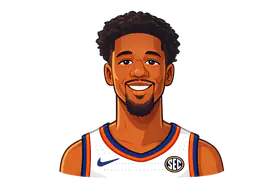
Kevin Overton
AuburnF · SrSpacing swing
Kevin Overton stretches Auburn's ceiling
His 41.3 percent shooting can keep help defenders away from Pettiford and the new interior targets.
76% confident
Duke Brennan
OklahomaC · GrPaint anchor
Duke Brennan changes Oklahoma's floor
A 10.3-rebound baseline gives the Sooners a dependable possession finisher behind a guard-led attack.
74% confident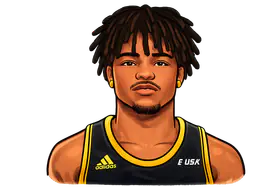
R.J. Johnson
Miss St.G · R-JrSecond creator
R.J. Johnson lightens Hubbard's load
His 14.4 points and 3.9 assists can prevent every late-clock possession from collapsing onto Hubbard.
70% confident
Jalen Shelley
Texas A&MF · JrFrontcourt hinge
Jalen Shelley gives A&M balance
His 13.7 points and 6.6 rebounds can connect a guard-heavy lineup without sacrificing size.
68% confident
ND Okafor
Miss St.C · R-SrInterior answer
ND Okafor protects Mississippi State
His rim protection must hold while an almost entirely new supporting cast learns SEC assignments.
67% confident
Five role changes worth buying
Breakout Team
Each selection has a verified baseline and a clear route to more impact.
Malachi Moreno
KentuckyC · SoBigger role
Malachi Moreno becomes Kentucky's backbone
His efficient finishing, passing and rim protection should scale with starter-level minutes.
78% confident
Amari Allen
AlabamaF · SoTwo-way leap
Amari Allen reaches star volume
Alabama can route more creation through a 6-foot-5 connector who already rebounded and defended.
75% confident
Patton Pinkins
Ole MissG · SoExpanded freedom
Patton Pinkins doubles the pressure
A 42.6 percent shooter now gets the minutes and actions to become Ole Miss' primary spacer.
72% confident
DeWayne Brown
TennesseeC · SoFrontcourt growth
DeWayne Brown claims the middle
His 58.6 percent finishing gives Tennessee a low-maintenance center beside four creators.
69% confident
Marcus Millender
GeorgiaG · SrBench to closer
Marcus Millender owns Georgia's offense
His 4.1 assists and 38.9 percent shooting support a clean move from part-time starter to lead guard.
66% confident
Three calls with consequences
Bold Predictions
Eleven bids, a farewell in Knoxville, and trouble in Lexington and Baton Rouge.
National revival
The SEC takes back No. 1
After a down 2025–26, the SEC reclaims its place as the country's best conference. A dominant nonconference performance gives the league the résumés to send 11 teams to the NCAA Tournament.
Confidence · 64%
One last run
Tennessee breaks through; Barnes bows out
Tennessee reaches its first Final Four, and Rick Barnes retires after the season. Three straight Elite Eight trips give way to the breakthrough that closes his career in Knoxville.
Confidence · 60%
Coaching fallout
Pope is out; LSU finishes last
Kentucky reaches the NCAA Tournament but loses in the first round, and Mark Pope is fired. Will Wade loses several LSU players to eligibility rulings, leaving the Tigers last in the SEC.
Confidence · 58%
Your turn on the record
Build your conference ballot
Make every call yourself, save your unfinished ballot on this device, and see where your picks agree with Shooty Hoops or go their own way.
Build your own board
Rank the league, draw your tiers, name fifteen All-Conference players, and hand out the hardware. Your draft stays on this device until you choose to publish it. You can return to the same link to edit and resubmit later.
Checking for a local draft
The crowd's ballot
Community consensus
See where completed fan ballots agree, where opinions split, and how the community compares with Shooty Hoops and your own picks.
Counting the room
Building the current community board…